Every lot Crescent Bioresearch supplies, with the signed certificate from the independent laboratory that tested it. Each record carries the endotoxin result as a number beside its limit, the lysate sensitivity and the volume. The full reading of every line follows below.
The record
Read a certificate, line by line
A certificate of analysis answers three questions: what the material is, how much of it is there, and what else is in it. Select a line to highlight it on the certificate and read what it records. The full explanation of every line follows below.
Kisspeptin-10, lot CBR-KIS-260411-001. BTLabs reports IF-824-QSA-TR006-BTL26742-05 and -11. Open the annotated certificate
The lines
What each line records
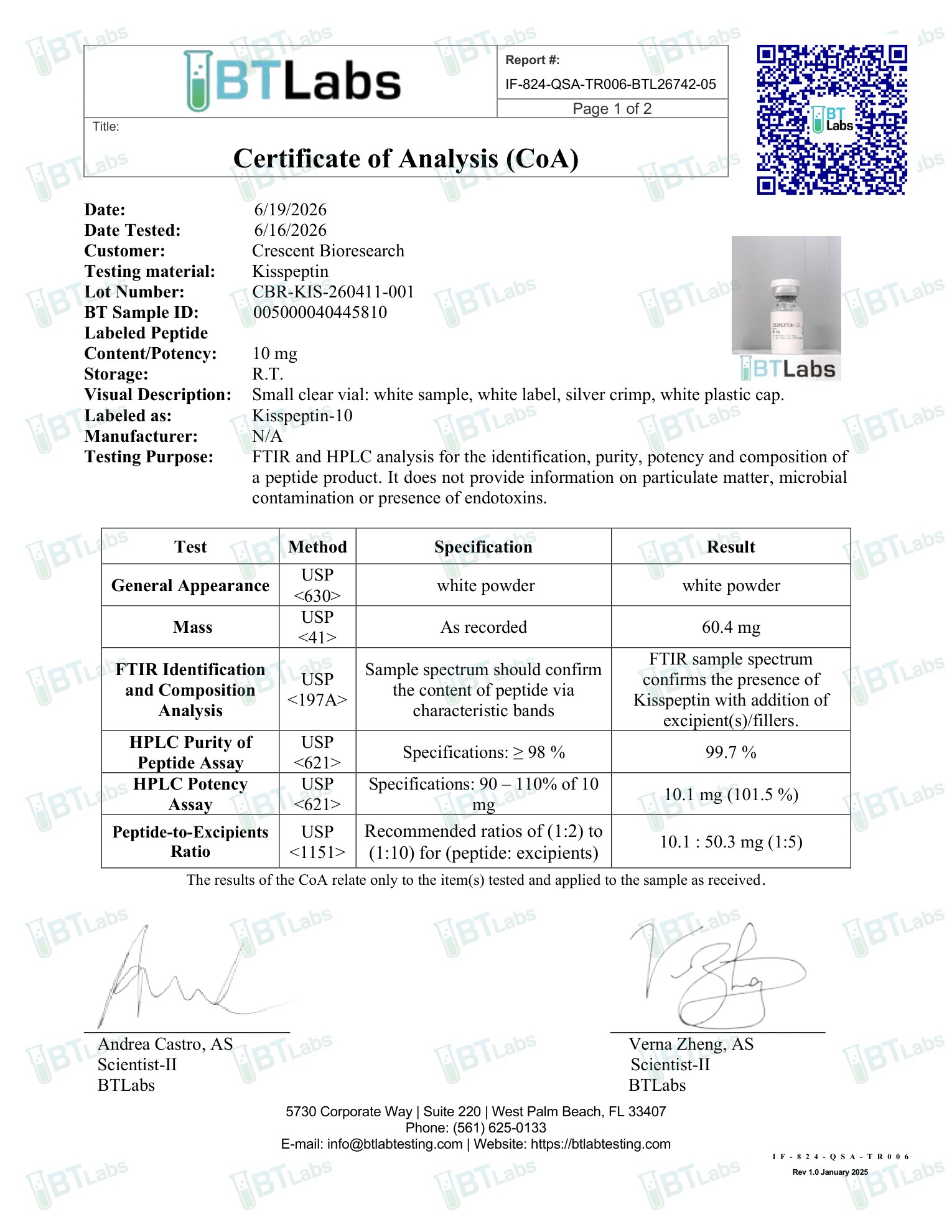
Kisspeptin-10, lot CBR-KIS-260411-001, tested by BTLabs, West Palm Beach, Florida. Identity, purity and content are on the first report; the bacterial endotoxin test is on its own report.
Identity
FTIR · USP <197A>
Spectrum confirms Kisspeptin
Fourier-transform infrared spectroscopy compares how the sample absorbs infrared light with the characteristic bands of the named compound. The laboratory records that the sample spectrum confirms Kisspeptin, with the excipient noted.
Identity comes first because every other figure on the certificate assumes the vial holds the compound on the label. A purity figure for the wrong compound means nothing.
Purity
HPLC · USP <621>
99.7% (specification: at least 98%)
High-performance liquid chromatography separates the sample into its components. Purity is the main peak’s share of all peak area in the chromatogram, read at 280 nm.
Purity describes composition. It says what share of the material is the named compound, not how much material the vial holds, and it does not detect bacterial endotoxin.
Content
HPLC · USP <621>
10.1 mg of a labelled 10 mg
The same chromatographic method, read against a reference standard, gives the mass of compound actually present in the vial.
Content is the figure a laboratory uses to prepare a solution of known concentration. It is also needed to convert an endotoxin value per milligram into a value per vial.
Verdict
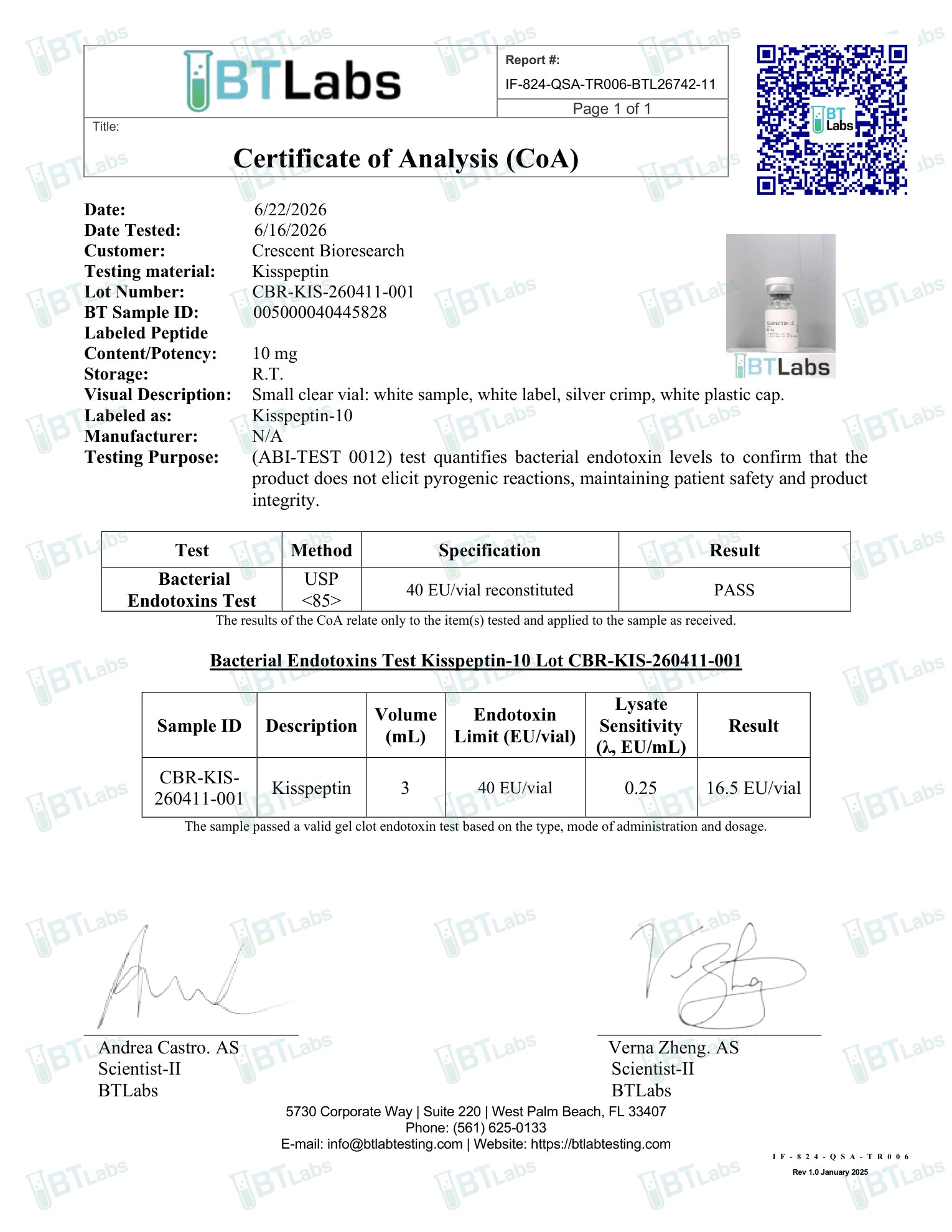
Bacterial Endotoxins Test · USP <85>
PASS against 40 EU per vial reconstituted
The verdict records that the measured endotoxin came in under the limit the laboratory applied. It is true, and on its own it is incomplete: it says the lot passed, not where it landed.
Most endotoxin certificates in circulation stop here. A verdict can only be checked when the limit and the measured value are printed beside it.
Limit
Endotoxin limit
40 EU per vial
The threshold this lot was judged against, printed on the page. A pass or a fail is the comparison of a measured value with this figure.
For a laboratory compound, the acceptable level belongs to the research entity and its model. Printing the limit lets a reader see which threshold the laboratory used, and printing the value lets the reader apply a different one.
Lysate sensitivity
Lambda, the labelled sensitivity of the lysate
0.25 EU/mL
The lowest endotoxin concentration the gel-clot lysate can detect, confirmed against reference endotoxin before any sample is tested. It describes the lysate, not the sample, and it is the same for every sample run with that lysate.
It is the figure most often mistaken for a result. Printed beside the measured value, it tells the reader how fine the measurement could be.
Volume
Reconstitution volume
3 mL
The volume in which the vial was reconstituted for testing. A value per milliliter becomes a value per vial only when it is multiplied by this figure.
Without the volume, an endotoxin concentration cannot be converted into the total the vial contains, and two certificates for the same vial can show figures that look unrelated.
Result
The measured endotoxin value
16.5 EU per vial
The measured endotoxin value: the figure the verdict was derived from. It is the number a research entity carries into its own calculation, against its own criterion.
Read with the other lines, it says that this vial carried 16.5 EU, or 5.5 EU/mL in 3 mL, against a limit of 40 EU per vial, measured with a lysate able to detect 0.25 EU/mL.
Read together
One vial, every unit
The endotoxin lines only become useful when they are read together. From the value, the volume and the content on this certificate:
Endotoxin per vial16.5 EU
Endotoxin per mL, in 3 mL5.5 EU/mL
Endotoxin per mg, for 10.1 mgabout 1.6 EU/mg
Share of the 40 EU limitabout 41%
Every figure above comes from lines printed on the certificate. A certificate that printed only the verdict would allow none of them. To convert another value, use the endotoxin converter.
 THE CRESCENT FOUNDATION